Related products
-
Arduino, Arduino Development Board's
Uno WiFi R3 Atmega328p NodeMCU ESP8266 8mb Memory USB-TTL CH340G Compatible
 Arduino, Arduino Development Board's
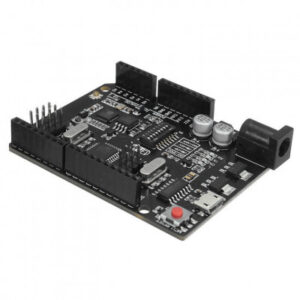
Uno WiFi R3 Atmega328p NodeMCU ESP8266 8mb Memory USB-TTL CH340G Compatible
Uno WiFi R3 AtMega328p+NodeMCU ESP8266 8mb Memory USB-TTL CH340G Compatible for UNO is full integration on one board: Uno R3 ATmega 328 and WiFi ESP8266 with memory 8Mb (MegaByte). All of the modules can work together or separately. And everyone has their own pinout headers.
The convenient solution for the development of new projects requiring Uno and WiFi. Via USB you can update sketches and firmware for ATmega328 and for ESP8266. For this onboard have the USB-serial converter CH340G.
It is a modernized version of the classic UNO R3 board. Full integration of a microcontroller ATmega328 and a Wi-Fi chip ESP8266 with 8 MB memory on one board. All modules can work together or individually. Each of the microcontrollers has led to connecting peripheral sensors and modules.
A convenient solution for developing new projects that require Wi-Fi. Through USB, you can update sketches and firmware for both ATmega328 and ESP8266. For this on board, there is a UART converter CH340G. The board has a DIP switch, which switches the modes of interaction of microcontrollers ATmegaa328 and esp8266.
Operations of this board are very simple. The board has DIP-switch, to connect the modules. For example, to USB and ATmega328, USB and ESP8266, ATmega328 and ESP8266.
SKU: n/a -
Arduino, Display
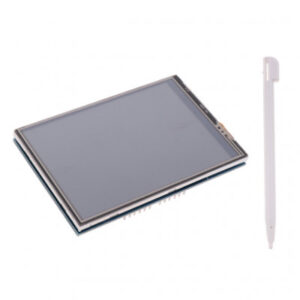
3.5 inch TFT LCD Touch Screen Display Shield for Arduino Uno
This small 3.5-inch touch screen module is designed specially for Arduino UNO. This is ideal for DIY anywhere, anytime, and does not require any separate power source or case to hold it. The screen also comes with a stylus to interact with the small screen.
Features of 3.5 inch TFT LCD Touch Screen Display Shield for Arduino Uno:-
- Resistive touch screen TFT LCD, 3.5inch, 480×320 resolution
- Standard Arduino interface, compatible with development boards like Arduino UNO, Leonardo, UNO PLUS, NUCLEO, XNUCLEO
- Onboard stand-alone touch controller, better touching than solutions that use AD pins directly for touch control
- PWM backlight control allows adjusting the backlight to a comfortable level
- Micro SD slot, provides an easy way to store photos for displaying
- Controlled via SPI, only a few Arduino pins are used
- Comes with STM32 and Arduino examples, convenient for porting
SKU: n/a -
Arduino, Arduino Development Board's
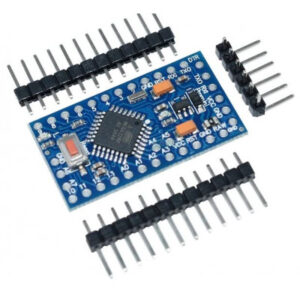
Pro Mini – ATMEGA 328P – 5V 16Mhz – Compatible Board
This is Pro Mini 5V/16MHz is a 5V running the 16MHz boot-loader. Pro Mini ATMEGA328P come without connectors.
It’s a great board that will get you up and running quickly. The Pro series is meant for users that understand the limitations of system voltage (5V), lack of connectors, and USB off board.
The Pro Mini is a micro-controller board base on the ATmega328. It has 14 digital input/output pins (of which 6 can be used as PWM outputs), 6 analog inputs, an on-board resonator, a reset button, and holes for mounting pin headers.
A six pin header can be connected to an FTDI cable to provide USB power and communication to the board. The Pro Mini is intended for semi-permanent installation in objects or exhibitions. The pin layout is compatible with the Mini.
SKU: n/a -
Arduino, Arduino Shield's
CNC Shield V3 – Engraving Machine 3D Printer A4988 DRV8825 Driver Expansion Board
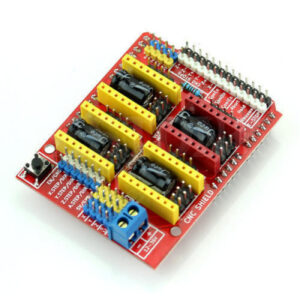 Arduino, Arduino Shield's
CNC Shield V3 – Engraving Machine 3D Printer A4988 DRV8825 Driver Expansion Board
The CNC Shield V3.0 allows you to build a engraving machine, 3D printer, mini CNC and other similar devices using your Arduino. It is designed as a shield and can plug on top of an Arduino requiring no external connections and wiring. There are 4 slots on the board for plugging in stepper motor drive module which can drive 1 stepper motor each. Controlling each step stepper motor requires only two IO pins on the Arduino. Just insert this Arduino CNC Shield V3.0 onto an Arduino UNO, and install the GRBL firmware, you can then quickly build a DIY CNC engraving machine.
SKU: n/a